


|
|
|
 |
 |
|
 |
| voltar / back | |
|
|
| Inauguração | |
| Opening | |
| 04. 11. 2017 22h / 10 pm Sábado / Saturday até 09. 12. 2017 until JOSÉ MARIA LOPES exposição ...................................................................... |
|
|
|
 |
|
|
|
...................................................................... LETTER 11/ (excerpts) The Law of Repetition • |
|
The Law of Continuity If there be no change at all in the shape or size of the objects, there is no continuity; there is only repetition-monotony. The Law of Curvature Well, as curves are more beautiful than straight lines, it is necessary to a good composition that its continuities of object, mass, or colour should be, if possible, in curves, rather than straight lines or angular ones. Graceful curvature is distinguished from ungraceful by two characters: first, its moderation, that is to say, its close approach to straightness in some parts of its course; and, secondly, by its variation, that is to say, it's never remaining equal in degree at different parts of its |
|
| ...................................................................... | |
|
|
 |
|
|
|
 |
|
|
|
 |
|
|
|
 |
|
|
|
|
|
|
|
 |
|
|
|
 |
|
|
|
 |
|
|
|
 |
|
|
|
 |
|
|
|
 |
|
|
|
 |
|
|
|
 |
|
|
|
 |
|
|
|
 |
|
|
|
 |
|
|
|
 |
|
|
|
 |
|
|
|
 |
|
|
|
| ...................................................................... José Maria Lopes |
|
|
|
|
|
| ----------------------------------------------------------------------------------------------------------------------------------------- | |
|
|
| Curadoria de: | |
| Curated by: | |
| Teixeira Barbosa | |
...................................................................... |
|
 |
|
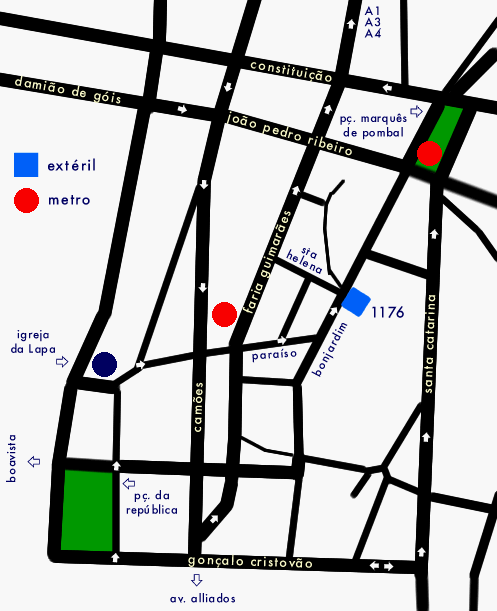
| Metro | |
| Subway | |
| - Faria Guimarães - Marquês de Pombal ...................................................................... |
|
|
|
| Localização | |
| Location | |
 |
|
|
|
| Rua do Bonjardim, 1176, Porto - Portugal | |
| Aberto na Inauguração | |
| Open at opening | |
| Visitas por marcação após inauguração | |
| Visits by appoinment after opening | |
| exteril@gmail.com | |
|
|
| ----------------------------------------------------------------------------------------------------------------------------------------- | |
| voltar / back | |
 |
|
